Organizing npbuy Brand Reviews: Size, Material, Service
Organizing npbuy Brand Reviews: Size, Material, Service
Organizing npbuy Brand Reviews: Size, Material, Service
When selecting products on npbuy's brand pages, you can't just look at whether reviews are mostly positive. A more useful approach is to split reviews into three categories—size, material, and after-sales—and then judge whether each comment can be verified against the product page, order records, or seller replies.
This article is for readers who are preparing to buy clothing, shoes, hats, or other products with significant usage differences, but are still unsure whether the reviews are sufficient to support a purchase. After reading, you should be able to do three things:
Locate the product and available review entry points on the brand page.
Sort reviews by specific issues instead of reading them all together.
Decide whether to continue verification, switch products, or delay the order based on the level of dispute.
This is not a conclusion about the quality of any specific brand. This article only explains how to organize evidence, and does not represent that the editor has personally purchased, received, or worn the products on the page. The content is compiled based on the public brand page information on np-buy.com, and the page fact-check date is October 2, 2026.
Locate Relevant Products and Review Entry Points on npbuy Brand Pages
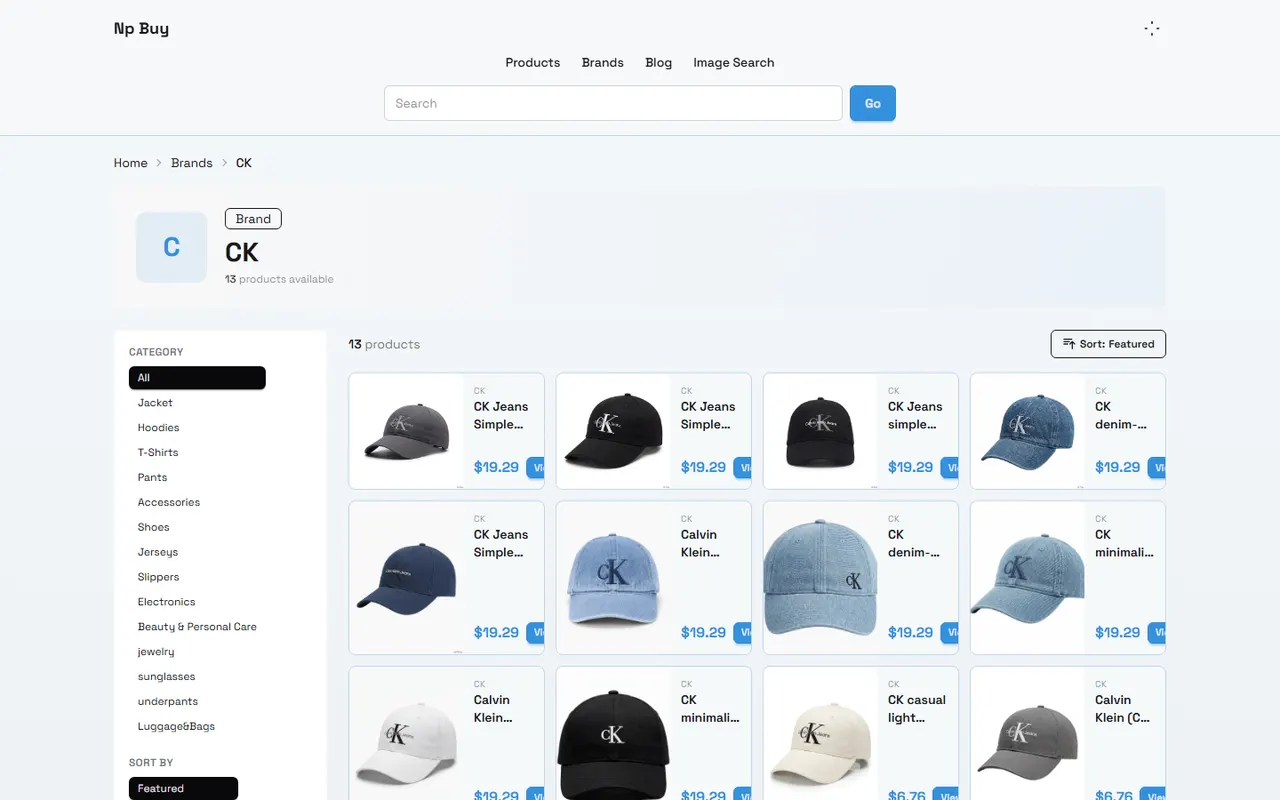
The public brand pages on np-buy.com allow you to view products by brand and provide category filters, sorting, and price filters. Taking the provided CK brand page screenshot as an example, the page shows that the brand has 13 available products, including items like hats, and provides options to sort by category, newness, price, and popularity.
First, locate the target product from the brand page, then enter the specific product page to view visible information. It is recommended to record the following:
Brand name and product title.
Product category.
Price, color, and size information displayed on the page.
Whether there are entries for reviews, buyer photos, seller replies, or after-sales instructions.
Whether the page can be opened and the information is complete.
If the brand page only has a product list with no visible review entry, do not treat product quantity, sorting position, or title similarity as review evidence. In this case, mark it as "review entry not found" and continue to check product details, specifications, and after-sales conditions.
The np-buy.com page also publicly introduces services such as supplier verification, price negotiation, order consolidation, and international shipping. For specific orders, you should still refer to the product page, order page, and actual applicable after-sales rules, and cannot assume that a product necessarily has specific protections based solely on the platform overview.
Sort Reviews by Size, Material, and After-Sales Categories
When reading reviews, first copy or excerpt sentences that are directly related to the purchase decision, then place them into the corresponding category. Do not directly put "like it", "not bad", or "fast shipping" into quality conclusions, because these lack comparable details.
For size-related reviews, focus on measurable information, such as height, weight, bust, waist, foot length, purchased size, and actual fit results. If a review only says "runs large" or "fits well", you need to confirm whether the reviewer's body data, wearing preferences, and product style are close to yours.
For material-related reviews, focus on distinguishing between page specifications and personal feel. The page may provide fabric composition, thickness, elasticity, or structure information; reviews may describe softness, scratchiness, breathability, or pilling. Personal feel can only be used as a reference, and cannot replace verifiable information in the composition label or product details.
For after-sales reviews, separately record at which stage the problem occurred: wrong color sent, size mismatch, missing accessories, shipping damage, or excessively long return and exchange processing time. Also distinguish whether the seller replied, whether a solution was proposed, and whether the reviewer stated the final outcome.
Category | Evidence to Record | Conclusions Not to Draw Directly |
|---|---|---|
Size | Body data, purchased size, measurements, fit result | Everyone should choose the same size |
Material | Composition label, thickness description, specific experience of wear or pilling | One touch-related comment proves material quality |
After-sales | Problem type, seller reply, processing time, final outcome | One complaint proves the platform will definitely reject after-sales |
When organizing, you can add three tags to each review: information completeness, verifiability, and relevance to the target product. This can prevent highly emotional reviews from carrying excessive weight. 🧾
Distinguish Verifiable Facts from Personal Feelings
Facts in reviews usually need to include a verifiable object. For example, "the page says L, but the received hang tag says M" is more suitable for evidence recording than "the sizing is ridiculous"; "shrunk about 2 cm after washing" is easier to verify further than "shrinks badly".
Personal feelings are not without value, but their applicable scope is narrower. Descriptions like soft, thick, thin, slimming, or scratchy are influenced by body type, season, washing method, lighting, and personal preference. When organizing, keep the original meaning and mark it as "subjective feeling".
Also check whether the review is indeed about the current product. Some brand pages may have products with similar names, different colors, different styles, or different sellers of the same brand. If a review does not clearly specify the product model, color, or order correspondence, do not treat it as direct evidence for the current product.
You can use the following judgment sequence:
Does the review clearly point to the current product?
Does it contain details such as size, specifications, time, or processing results?
Can it be corroborated by the product page, order information, or seller reply?
Might the conclusion in the review apply only to the reviewer?
Are there other reviews that state the opposite?
Only content that has both a clear object and sufficient details is suitable to influence the purchase decision. 📏
Handle Contradictions and Insufficient Samples in Reviews
Contradictions in reviews do not necessarily mean one of them is fake. Size differences may come from different batches, colors, measurement methods, or wearing preferences; material evaluations may be affected by season and washing method; after-sales experiences may vary due to seller, order time, and problem type.
When encountering contradictions, first split by product variants, then sort by time. Prioritize checking:
Whether it is the same product title and specification.
Whether it is the same color, size, or version.
Whether the reviews are from a similar time period.
Whether there are product images, measurement data, or seller replies.
Whether the same issue appears repeatedly in multiple independent reviews.
If there are only one or two reviews, or the reviews contain only emotional words, mark it as "insufficient sample". Insufficient sample is not a negative conclusion, but indicates that the current evidence cannot support a stable judgment.
If there are many reviews, you also cannot just look at the total number. Observe whether specific issues repeat, whether reviews contain valid details, and whether negative reviews are concentrated on the same variant or time period. Large quantity does not equal high evidence quality. ⚖️
Build a Review Evidence Record Table
It is recommended to create a record for each product you plan to buy to avoid comparing based on impressions across multiple pages. The record can be in a spreadsheet, note-taking tool, or order verification checklist; the tool itself is not the conclusion, the key is to keep the fields consistent.
Recommended fields are as follows:
Product title and page identification information.
Review date or visible time.
Review category: size, material, after-sales, or other.
Summary of original facts.
Summary of subjective feelings.
Whether there are images, measurements, or seller replies.
Verifiable source: product page, order page, specification description, or after-sales record.
Evidence level: clear, partially clear, cannot verify.
Impact on purchase decision: continue verification, acceptable risk, delay order.
If using a spreadsheet, it is recommended to record only one issue per row, and not stuff an entire paragraph of review into one cell. This makes it easier to count "how many times size disputes appear" and "whether material problems are concentrated in a certain version", and also facilitates item-by-item verification during later inspection. Compared to just saving URLs or screenshots, structured records are more conducive to discovering repeated problems; but still be careful to cover order numbers, addresses, phone numbers, and payment information. 🔒
Decide Whether to Continue Verification or Delay the Order Based on Dispute Level
When reviews show minor and explainable differences, such as different size perceptions due to body type, you can continue to check the size chart and actual product measurement information. If the platform or seller can provide clear measurements, the evidence is usually more useful than a simple "runs large" or "runs small".
When material reviews show repeated and specific problems, such as multiple buyers mentioning the same pilling, odor, or fabric composition not matching the page description, you should first request verification of product specifications, batch, or after-sales conditions before deciding to purchase.
When after-sales reviews involve receiving the wrong product, inability to process returns or exchanges, or inconsistencies between the product page and actual item information, you should increase caution. Before ordering, save the product page information, confirm the available after-sales window, required photos or proof, and possible return costs. Do not design order plans to evade inspection, reduce declaration, or avoid due fees; customs, taxes, and import restrictions should be handled according to destination country rules.
When the following situations occur, delaying the order is usually safer:
The review entry cannot be confirmed, and the product page information is incomplete.
The size chart, product title, and review descriptions contradict each other.
Multiple independent reviews repeatedly point out the same specific problem.
The seller has not clearly replied to key issues.
Return/exchange conditions, time limits, or responsible fees cannot be confirmed.
The color, size, or version you need lacks sufficient corresponding evidence.
This organizing method does not turn reviews into absolute conclusions, but it lets you clearly know: which information has been verified, which is just personal feeling, and which risks remain unresolved. For products on npbuy brand pages, the most reasonable next step is usually to complete verification of product specifications and after-sales conditions before deciding to order; if evidence is insufficient, keep records and delay, rather than replacing a complete judgment with a single highly emotional review.
Common Questions About Agent Platform Shopping
1. What reasons make Google Sheets unsuitable for np-buy.com's product management?
Google Sheets can handle only a tiny product count. When you list many items, pages crawl, mobile views become terrible, and locating any specific product is a struggle. On np-buy.com, the same catalog loads more quickly and shows a cleaner, user-friendly layout.
Browse our latest products and find your next favorite item.